Your AI agent can read your codebase. It can't read your mind
Code captures roughly 40% of a product's identity — the other 60% lives in design decisions, interaction principles, and things never written down, which is exactly why agentic coding tools produce generic output.
Your agent has read every line you've ever shipped. It still builds things that feel like someone else's product. That's not a model problem. It's a context problem — and the context it's missing was never in the code to begin with.
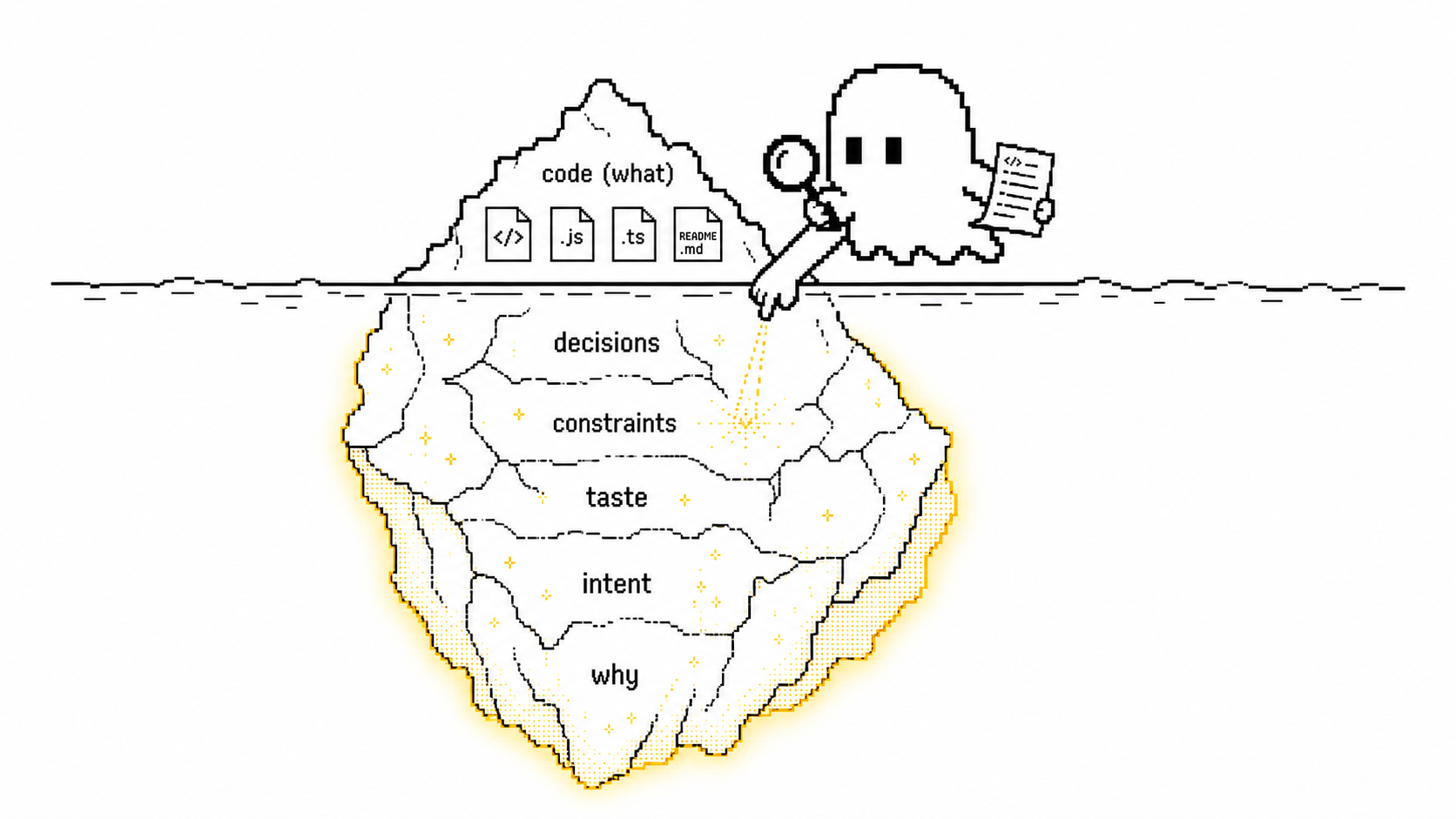
Point an agent at your repo and it sees a complete picture: every component, every route, every utility, every test. It can describe your architecture better than half your team. So why does the feature it ships feel generic — technically correct, structurally fine, and somehow wrong?
Because code is the output of a thousand decisions, not a record of them. Code can express what it does, but it's much harder for code to express why. The context for software lives outside the software. A legacy file is full of patterns shaped by old constraints, half-finished migrations, local workarounds, and decisions nobody wrote down. The agent inspects the result. It cannot recover the intent.
Think about what actually defines your product. Why the destructive action sits behind a confirm, but only for shared workspaces. Why onboarding skips a step for returning users. Why your empty states say one specific thing and never another. Why latency over 600ms gets a skeleton and under 600ms doesn't. None of that is in the code as reasoning. It's in the code as a fact, stripped of the judgment that produced it. The agent inherits the fact and guesses at the judgment — and its guess is the statistical average of every other product it was trained on. That's the generic smell. It's the sound of your taste being replaced by a global mean.
This is why "just give it the whole codebase" doesn't fix it. When the reasoning behind a behavior disappears, teams fall back on assumptions, and defects follow. Your agent does the same thing, faster. The dangerous part: it cedes design decisions back to you without anyone noticing one was made. It picked a pattern. You merged it. Neither of you decided anything on purpose.
Getting it right means you stop expecting the model to infer intent and start making intent a first-class input. A few habits separate teams that get specific output from teams that get generic:
- Write the why down, once, where the agent reads it. Tacit knowledge — the judgment your team applies without articulating — is exactly what an agent can't absorb from code. Put it somewhere the agent reads by default: a conventions file, design principles, the rules behind your patterns. "We never use a modal for a reversible action." "Primary actions are always bottom-right." Not style nits — the decisions that encode your taste.
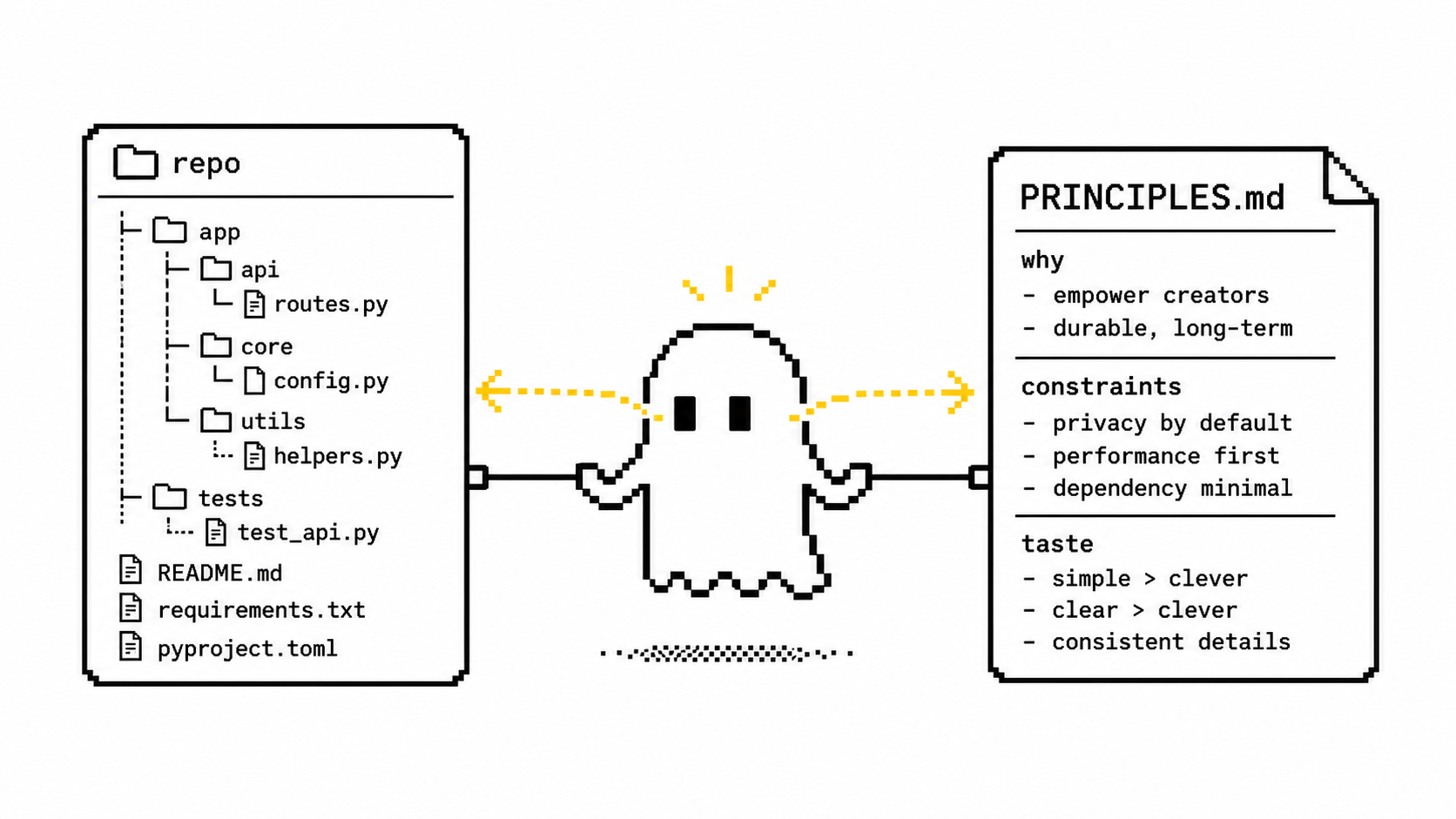
- Give decisions, not just instructions. A prompt that says "add a settings page" gets you the average settings page. A prompt that says "add a settings page; destructive actions confirm only when they affect other users; we group by frequency-of-use, not alphabetically" gets you yours. The decision is the differentiator. Spend your words there.
- Treat the missing 60% as an asset you maintain, not overhead. The reasoning, constraints, and patterns-with-rationale that aren't in the code are your actual moat. Codify them so the agent compounds your taste instead of averaging it away.
- Review for intent, not just correctness. When you review agent output, the question isn't "does it work" — it usually does. It's "did it make a decision I wouldn't have?" That's where generic creeps in. Catch the silent decisions and either accept them on purpose or overrule them.
- Capture the why at the moment you decide it. The cheapest time to record intent is when it's fresh — in the PR, the design doc, the commit message. A design doc's real value isn't the launch; it's becoming the historical record of why, so the next person (or agent) doesn't unknowingly undo it.
The reframe: an agent that can read your codebase has access to your answers. It has none of your reasoning. If you only feed it the repo, you've handed it a finished exam with the working erased and asked it to match your thinking. It can't. It'll match everyone's. The work now isn't writing the code — the model does that. The work is writing down the judgment that used to live only in your head, so the thing it builds is recognizably, specifically yours.
Try this on your own setup. Open the last feature your agent built and find three decisions inside it — a default, an interaction, an edge case. For each, ask: did I decide this, or did the model? Then ask: is the reasoning written down anywhere the agent could read it? If most of your product's "why" lives only in your head and your team's, you don't have an AI output problem. You have an undocumented-intent problem, and it'll get more expensive every sprint the agent ships on top of it.
Sources
- Building shared coding guidelines for AI (and people too) — Stack Overflow
- Developers need more context than you think they do. Here's why. — Test Double
- AI-Infused Development Needs More Than Prompts — O'Reilly
- Tacit Knowledge Is Your Next Competitive Moat — California Management Review
- Codifying Tacit Knowledge: The Missing Layer Between Your Team's Conventions and Your AI Assistant — DEV Community