The agency that built your AI product moved on. That's the real design risk.
When the agency that built your AI product moves to their next client, the design intent walks out the door with them. Models silently update, behavior drifts, and nobody on your team knows what 'working correctly' was supposed to mean.
Your AI product shipped 8 months ago. The agency that built it is deep into three new projects.
That's fine — that's how agency engagements work. The problem isn't the timeline. The problem is what walked out the door with them: the design intent behind every decision your AI system makes.
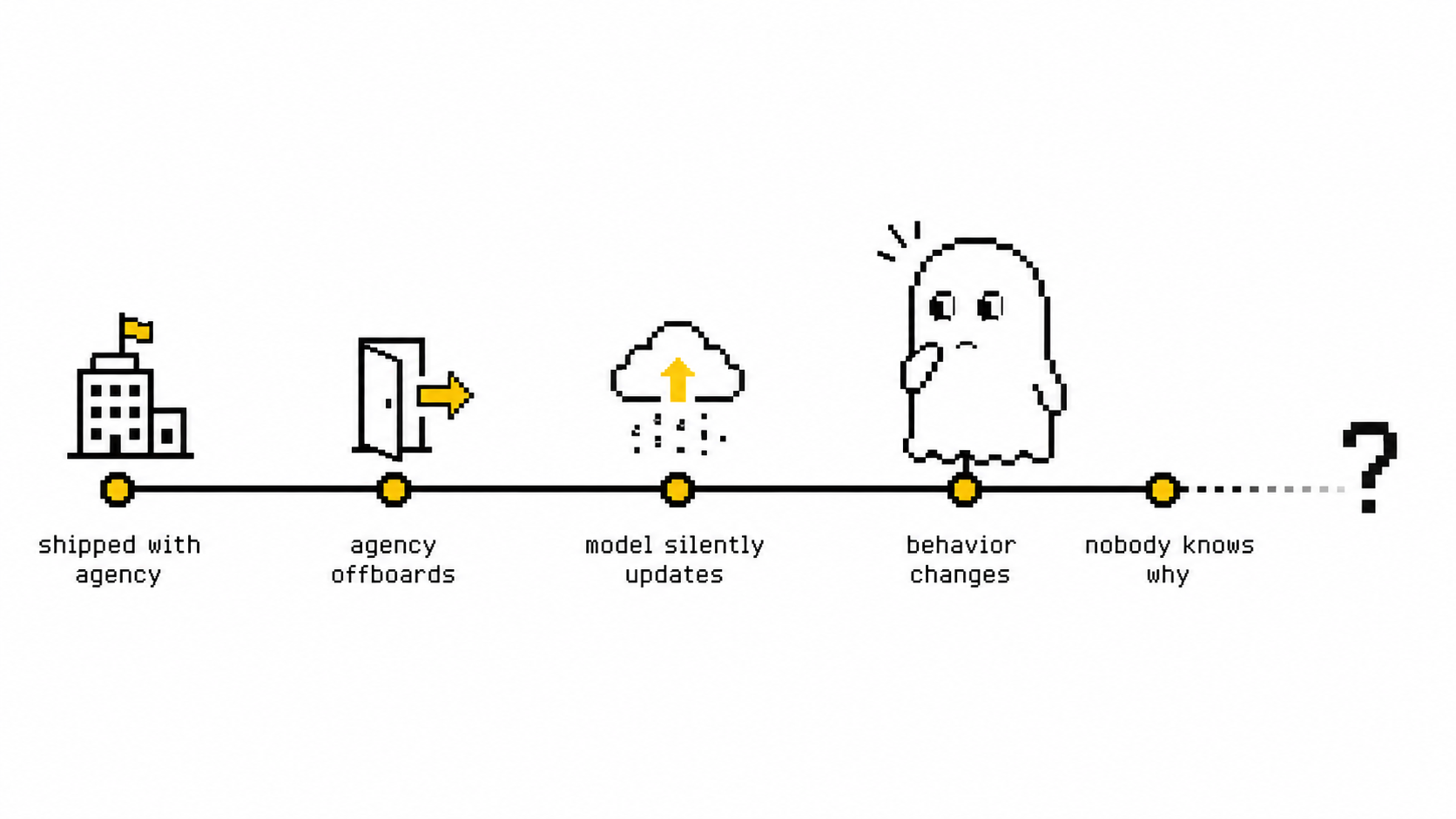
Almost nobody talks about this in agentic AI: the underlying model silently updates. OpenAI, Anthropic, Google push model changes that alter behavior without any announcement loud enough to reach your product team. The model your system shipped on in March may not be what's answering requests in September. Small prompt sensitivity shifts. Slightly different edge case handling. Changed defaults on ambiguous instructions.
In a traditional software product, a bug is traceable. You find the commit, you read the code, you understand what changed. In an agentic product, the AI's behavior is shaped by the interaction of model weights, system prompt, user prompt, and retrieved context — none of which is version-controlled by default, and most of which was designed by people who are now working on something else.
40% of agentic AI projects are projected to fail by 2027, according to Gartner. The reason cited isn't bad models. It's bad governance — teams that shipped fast and never built the internal muscle to own what they shipped.
Model drift makes this worse. Behavioral drift doesn't announce itself. Your AI starts giving slightly different responses, handling edge cases differently, or degrading in a specific scenario. Without someone who understands what the system was designed to do — the original reasoning, the tradeoffs, the scenarios that were explicitly considered — you're debugging a system you've already forgotten.
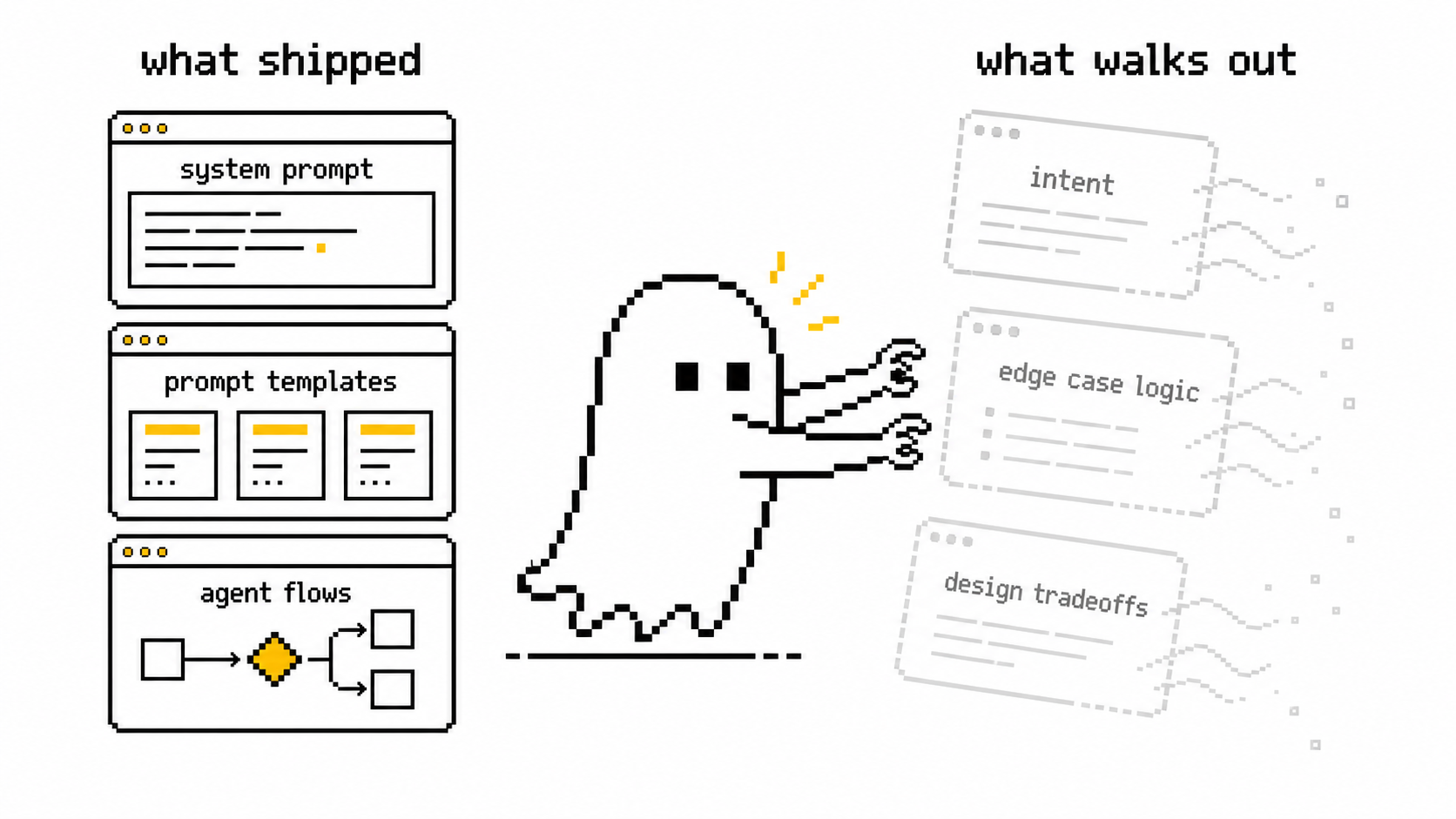
What good looks like isn't complicated, but it requires a decision to own the thing you built:
Document the design decisions, not just the system prompt. Why does the AI handle X this way? What edge cases were considered? What was deliberately not included and why? That reasoning is what makes debugging possible and iteration coherent.
Set up behavioral monitoring before you need it. Regression tests on key scenarios. Output sampling. The ability to compare agent behavior today to agent behavior three months ago on the same inputs. Drift detection doesn't require a research team — it requires a checklist and the habit of running it.
Establish internal ownership, not just vendor access. Someone on your team needs to understand what the AI is supposed to do deeply enough to catch when it stops doing it. That can't be delegated permanently to an external vendor.
The agencies that built your product weren't being irresponsible. They delivered what was scoped. The risk is on the product side — treating an agentic system like a web app you hand off and monitor with uptime checks.
Agentic products don't deprecate cleanly. They drift. And the only way to catch the drift is to have someone who understood the original intent still inside the building.
Try this now. List the five most important things your AI system is supposed to do. Then ask: if the model behavior changed on any of these tomorrow, would your team know? Within a day? Within a week? If the answer is "probably not," that's the gap — not the model, not the vendor, but the missing internal knowledge of what "working correctly" actually means.
Sources
- LLM Model Drift Detection 2026: Monitoring AI Degradation — StackPulsar
- Enterprise Agentic AI Landscape 2026: Trust, Flexibility, and Vendor Lock-in — Kai Waehner
- Why Most Agentic AI Projects Fail (And How to Succeed in 2026) — AI Agent Corps
- Gartner: 40% of agentic AI projects will fail, making humans indispensable — MarTech
- Agentic Workflows in 2026: The ultimate guide — Vellum