Nobody calls an agency when the building is on fire
The project-based agency model hands you a polished snapshot and walks away. AI products never stop moving — which is why they need continuity, not deliverables.
Think about how an agency engagement actually works. You scope a project. You agree on deliverables. They disappear for six weeks, then hand back a polished artifact and an invoice. The model is a relay race: a clean baton pass, then they're off the track.
Now look at how an AI product actually moves. The model gets better every few weeks. Users get more sophisticated as they learn what the system can do. The interaction that made sense in month two looks wrong by month six — not because anyone designed it badly, but because the ground moved underneath it. A project-based engagement gives you a snapshot of good design at one moment. Three months later that snapshot is already stale, and the agency that made it is gone.
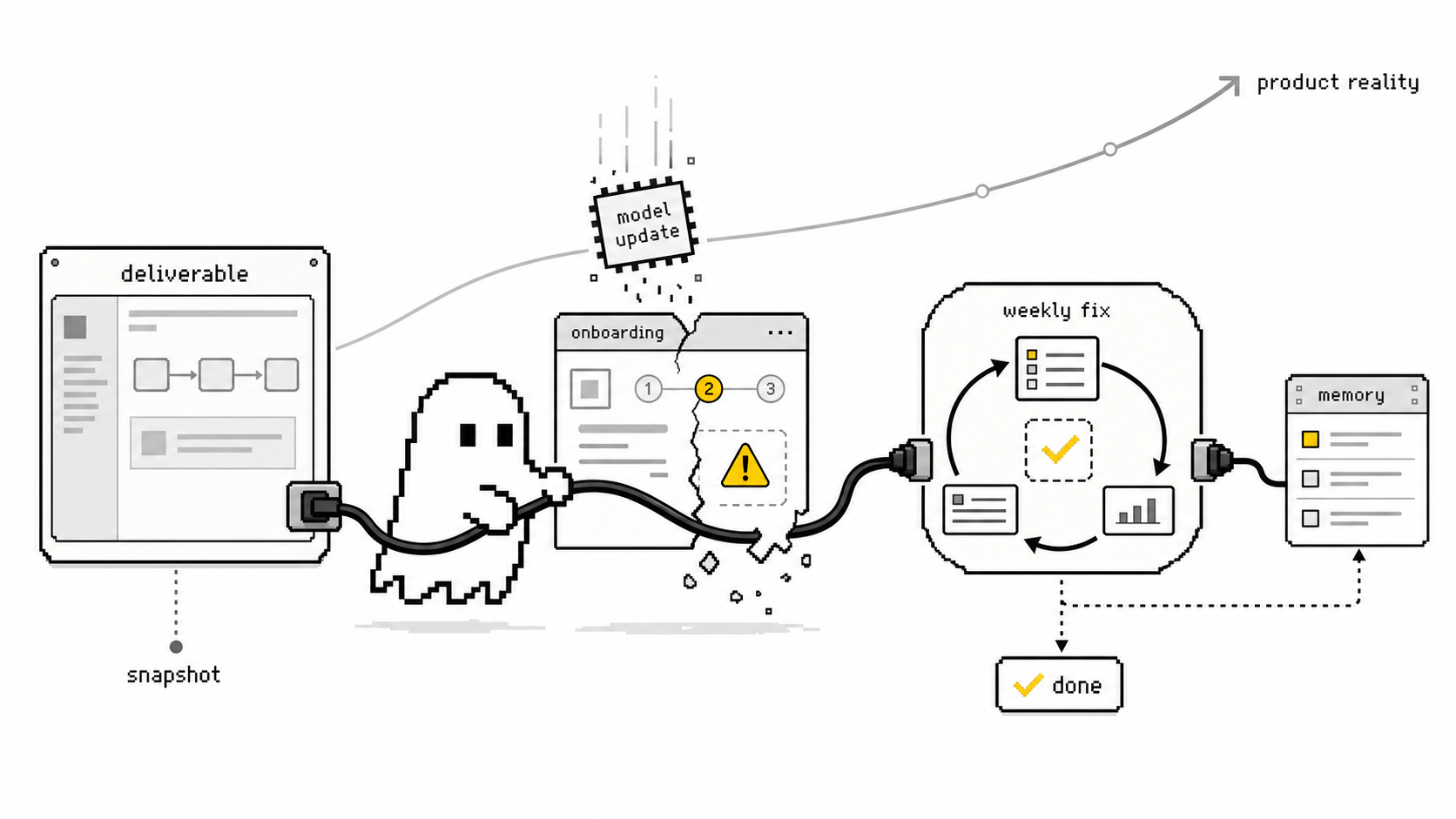
This is where the agency model fails founders. You don't call an agency when the building is on fire — when a model update just broke your onboarding flow, when a competitor shipped a pattern that makes yours look ancient, when you need a decision today, not a statement of work next Tuesday. The agency model has a built-in latency that continuous products can't absorb. By the time the relay baton comes back, the race has moved to a different track.
The deeper problem is design debt. Every interface decision an AI product ships is provisional — it assumes a model capability, a user mental model, a competitive baseline. When those assumptions shift and nobody is there to revise the design, the gaps compound. A common pattern: an onboarding flow built around a model's early limitations stays in place long after the model outgrows them — users bump into guardrails that no longer exist. Confusing states pile up. Dead ends never get fixed. Get product design wrong in the first twelve months and you spend multiples of that time unwinding it. A project model practically guarantees this: it's optimized to deliver and exit, not to stay and maintain.
So what does getting it right look like? Stop buying deliverables and start buying continuity. The unit of value for a fast-moving product isn't a Figma file — it's a standing capability that shows up every week with full context. The teams that win at this share a few traits:
- Design lives inside the product loop, not beside it. Whoever owns design is in your standups, watching user sessions, in the Slack channel where the model's failures get reported. Context isn't re-acquired each engagement; it accumulates. The best embedded partnerships ship in under a week precisely because there's no ramp-up tax every time.
- The relationship is priced for "always," not "once." A monthly capacity model — internal hire or embedded partner — beats a per-project quote for anything that evolves. You're paying for someone to keep the design correct as reality changes, not to drop a finished object and vanish. Embedded retainers commonly run $6K–7K/month versus the $150K+ all-in cost of a senior full-time hire, which is why seed-stage teams use them to buy runway.
- Speed of revision is the real metric. For an AI product, how fast you can fix a broken flow matters more than how polished the original was. Optimize your design setup for short revision cycles, not big reveals.
- There's a single owner of design judgment. Not a rotating pool, not a new account team each quarter. One person or small group who remembers why the last three decisions were made — because in a product that never stops moving, memory is the deliverable.
The decision underneath all of this: are you resourcing design as a series of projects, or as a continuous function? Most teams never consciously choose. They default to projects because that's how design has always been bought — and then wonder why their product feels like it was designed by five different people who never met. The mismatch isn't anyone's fault. It's the wrong shape of engagement for the shape of the work.
Try this audit on your own setup. Answer three questions honestly:
- When a model update breaks a flow on a Tuesday, how many days until someone with design authority can fix it?
- Does whoever owns your design remember why your current patterns exist, or do they re-learn your product every engagement?
- Are you paying for finished artifacts, or for the design to stay correct as your product changes?
If your answers point to slow, re-learns, and artifacts — you're running a relay race in a sport that never stops moving. The fix isn't a better agency. It's a different shape of engagement: continuous, embedded, and owned by someone who stays.
Sources
- Product Design Agency for AI Startups in 2026 — Foundey
- Embedded Design Team vs Hiring a Full-Time Designer — Foundey
- Working with a UX Design Agency vs. an In-House Team — Clay
- In-House Designer vs. Agency: Advantages and Disadvantages — Uitop
- When to Hire a Product Designer vs Use a Design Agency — Foundey